SAP consulting that protects the clean core
SAP consulting at BCS locks in the architectural decisions that decide whether the next decade of SAP investment compounds value or accumulates modification debt. Most programmes that struggle through the 2027 ECC cut-over trace back to consulting choices made years earlier, not implementation execution.
30-minute discovery session.
SAP ends mainstream ECC maintenance in December 2027, with extended support to 2030 (SAP).
Majority of S/4HANA transitions carry ABAP modifications that constrain clean-core upgrade adoption (Gartner).
Typical SAP transformation decisions involve 22 stakeholders across IT, finance, operations, procurement (Forrester).
Which SAP consulting path fits the landscape?
SAP consulting is not a single engagement. It is the architectural and commercial work that turns a buyer's specific starting point into a decade-long roadmap. BCS structures the engagement around two recognisable starting states, with scope, deliverables, and platform integration calibrated to each.
Adopting SAP for the first time
SAP S/4HANA, BTP, or SuccessFactors selected as the strategic platform. BCS designs the solution architecture from first principles: clean core, right-fit integrations, and Symphony agents scoped into the design from the first workshop, not deferred to a later phase.
- Architecture blueprinting from zero technical debt
- SAP Best Practices baseline with BCS accelerators
- Independent RISE versus GROW evaluation before commercial signature
- Symphony, deKorvai, Anugal scoped pre-contract
Modernising the existing landscape
Running ECC, legacy BW, or a heavily customised S/4 landscape. BCS assesses the modification footprint, designs the retirement path for code that should not migrate, and executes the conversion with selective data migration where the business case demands it. Business continuity through cut-over is non-negotiable.
- Custom code impact analysis and retirement roadmap
- Brownfield conversion or selective data migration
- Parallel data quality workstream from Prepare phase
- Zero-defect cut-over with pre-built reconciliation tooling
Why do most SAP transformations fail?
Programmes that run over budget, miss go-live, or land with critical defects almost always trace back to consulting decisions made before the implementation contract was signed. Six patterns are documented across major analyst research. BCS consulting is structured to eliminate each one from the first workshop.
What SAP consulting delivers
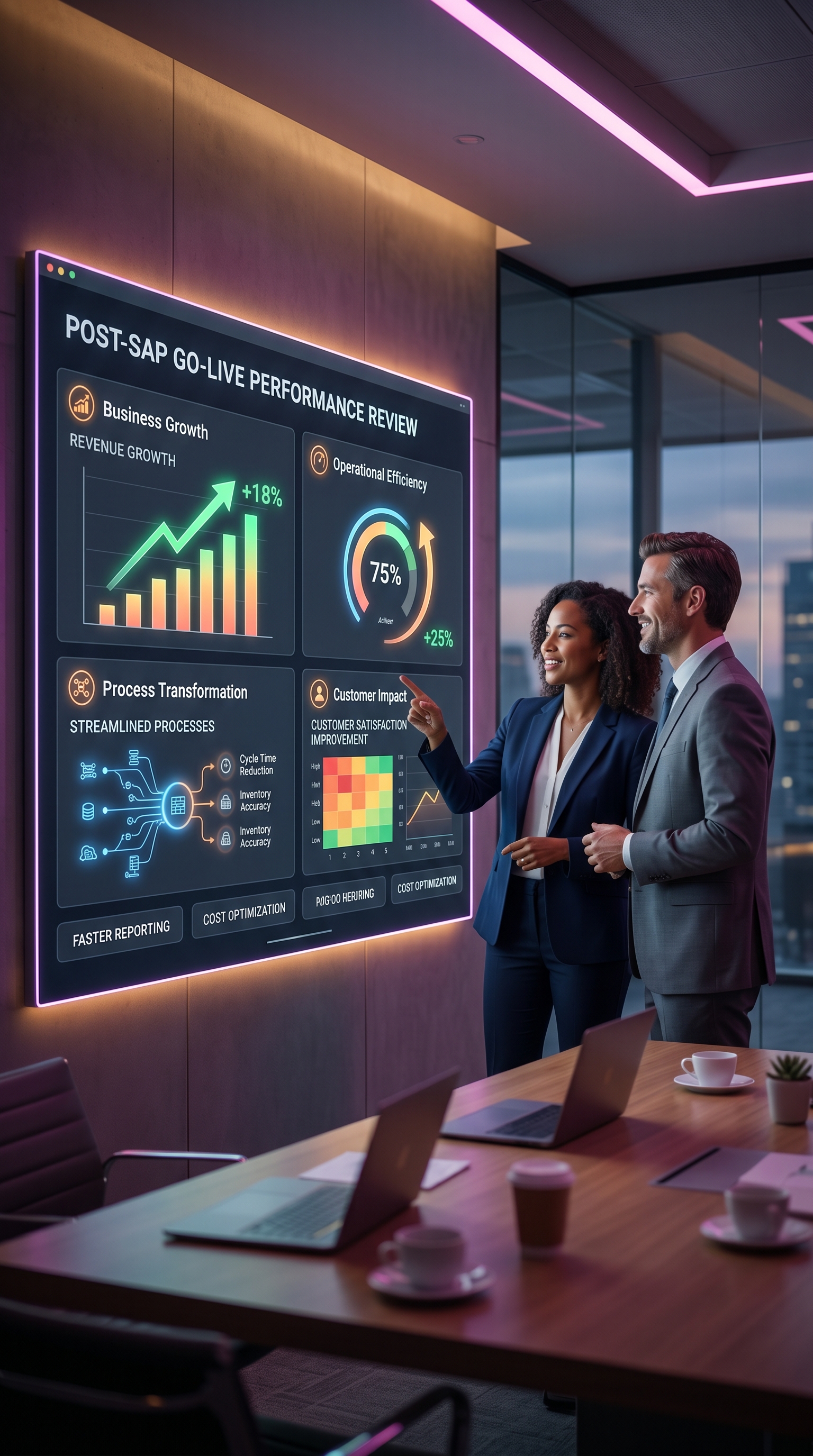
SAP transformation is a board-level initiative funded against measurable business outcomes, not configured features. The decisions made in consulting determine which outcomes land at go-live and which decay through change requests. Six outcomes anchor every BCS SAP engagement, scoped against the business case.
One trusted digital core
A single source of truth across business units, eliminating duplicate masters and conflicting KPIs that delay leadership reporting.
Financial close in days, not weeks
Real-time consolidation replaces multi-day cycles. Books close in the first calendar week of every period from go-live.
Permanent roadmap optionality
Clean-core architecture lets the business adopt every quarterly SAP release without re-implementation. The platform stays current indefinitely.
Audit-ready compliance posture
Continuous controls monitoring through Anugal replaces periodic compliance reviews. Audit evidence is generated as a byproduct of operations.
Lower steady-state TCO
Symphony agents absorb routine operational workload post go-live, reducing the ongoing headcount required to run the platform.
Skilled capacity redirected to judgment
Routine transactions, exceptions, and approvals run through Symphony. People focus on policy, exception design, and continuous improvement.
How is SAP Activate delivered inside a BCS engagement?
BCS delivery is built on SAP Activate, the agile framework SAP publishes for every cloud and on-premise programme. Each phase carries two BCS additions on top of standard outputs: a clean-core gate that blocks scope creep into the standard namespace, and an agentic readiness checkpoint.
Discover
BCS runs business process workshops and fit-gap analysis to lock scope on demonstrated SAP capability. The output is a quantified business case with the clean-core gate already applied to every in-scope process.
Prepare
Project governance, environment setup, integration architecture, and an SAP Best Practices baseline are established. The parallel data quality workstream and the agentic readiness checkpoint activate alongside configuration design.
Explore
Fit-to-standard workshops confirm the solution design across every in-scope process. BTP extension architecture is defined for anything that must stay outside the standard SAP core.
Realize
Iterative configuration, integration build, data migration, and testing run as parallel workstreams. Symphony agents are configured alongside SAP processes so automation is ready at cut-over, not deferred.
Deploy
BCS executes cut-over with reconciliation sign-off and runs structured hypercare with severity-based SLAs. Symphony agents are operational from the first production day, absorbing the L1/L2 peak that follows go-live.
Run
Steady-state operations run through continuous improvement sprints and quarterly SAP release adoption. The clean-core gate governs every change, keeping the upgrade path permanently open.
How does BCS consulting deliver impact?
Senior practitioners across nine domains coordinate on every BCS SAP consulting engagement. Each domain carries certified SAP capability, vendor-anchored methodology, and BCS accelerator tooling. Joule enablement and clean-core architecture are not standalone capabilities. They are embedded across every other practice on the page.
Finance Transformation Advisory
S/4HANA finance architecture: Universal Journal configuration, financial close redesign, Central Finance for multi-entity consolidation, Group Reporting, and Treasury. BCS architects have closed monthly books in SAP, not just configured the screens.
Supply Chain and Operations Strategy
Network design, procurement architecture, demand planning, and digital manufacturing advisory. Covers MM, EWM, PP, SD, and Ariba connectivity, with BTP extension boundaries defined per process.
HCM and SuccessFactors Advisory
HR process harmonisation, SuccessFactors solution design, global payroll strategy, and workforce analytics. Full employee lifecycle design with S/4HANA integration and country-specific localisation.
SAP Joule and Business AI Enablement
Joule deployment, conversational AI integration in SAP workflows, and Business AI use-case identification. Prerequisite assessment covers Fiori adoption, master data readiness, and BTP foundation.
Organisational Change Management
Stakeholder engagement design, role-based readiness assessment, training architecture, and adoption measurement. OCM runs phase by phase as a measured delivery workstream, not a sign-off exercise.
Clean Core Architecture
Technical blueprint design, custom code retirement strategy, BTP extension architecture, and cloud migration advisory. Every BCS engagement enforces clean-core boundaries so the quarterly release path stays open.
Integration Architecture Advisory
Integration landscape design, middleware strategy, API governance frameworks, and SAP Integration Suite implementation. Architecture decisions in consulting define integration TCO for the next decade.
Data Strategy and Governance
Master data management design, data quality programmes, analytics foundation architecture, and Datasphere readiness assessment. Data strategy established before migration begins, not discovered during it.
Technology Roadmap and Vendor Selection
SAP product selection advisory, RISE versus GROW evaluation, licensing strategy, and multi-year roadmap design. Independent advice before commercial signature, with no vendor incentive shaping the recommendation.
What other SAP partners cannot offer?
Every BCS SAP engagement embeds three proprietary platforms into the solution architecture from the first workshop. Symphony runs autonomous operations, deKorvai surfaces AI-driven decisions, and Anugal embeds continuous compliance monitoring. None are optional add-ons. They are why BCS outcomes look different.
 Agentic Operations Platform
Symphony
Symphony agents are deployed inside SAP workflows at go-live, autonomously handling approvals, exception management, period-end orchestration, and reconciliation. In a BCS consulting engagement, agent workflows are scoped during process design, so autonomous operations are live with the system rather than deferred to a Phase 2 that never arrives.
- Autonomous AP/AR exception handling
- Automated period-end close orchestration
- Self-healing workflow error resolution
- Real-time operational reporting
 AI Decision Intelligence
deKorvai
deKorvai sits above the SAP data layer and surfaces predictive and prescriptive intelligence: demand signals, supplier risk, and cash flow forecasting. In SAP consulting, deKorvai use cases are identified during process design, with the data foundation, signal definitions, and decision pathways scoped before the analytics build begins.
- Demand sensing and inventory optimisation
- Cash flow forecasting with variance explanation
- Supplier risk and disruption early warning
- Anomaly detection across financial transactions
 Compliance and Controls Automation
Anugal
Anugal embeds continuous controls monitoring inside SAP processes from the first period close. In consulting, segregation-of-duties matrices, access-risk models, and audit-evidence flows are designed alongside the process architecture, replacing periodic compliance reviews with real-time assurance that is operational on day one of production.
- Continuous SAP segregation of duties monitoring
- Automated audit evidence collection
- Real-time regulatory reporting for SOX, IFRS, GDPR
- Access risk analytics and remediation workflows
Frequently Asked Questions
Refer to this section for answers to frequently asked questions related to SAP consulting.
When should SAP consulting begin relative to the implementation contract?
RISE with SAP versus GROW with SAP, which fits an enterprise landscape?
What is clean core, and why does consulting decide whether it survives?
How does Symphony differ from SAP Build Process Automation in a consulting context?
What does the 2027 SAP ECC deadline mean for consulting timing?
What makes BCS different from every other SAP consulting partner?
BCS has 12 years of SAP delivery and 40+ enterprise programmes shipped across finance, supply chain, HCM, and clean-core conversions. Where the differentiation lives is in the structural choices made before the engagement begins, not in the slide decks shown after the contract is signed.
Outcomes, not phase completions
Engagements are scoped against measurable business results: close cycle, transaction cost, autonomous workload. Billable Activate phase completions are not the success metric on a BCS commercial.
Agentic platforms designed in at consulting
Symphony, deKorvai, and Anugal are scoped during the consulting phase, not added as Phase 2 line items. Automation outcomes are committed to the business case before the implementation contract is signed.
Clean core is contractually enforced
No ABAP modifications in the standard namespace on a BCS engagement. Every differentiator is built as a BTP extension. The quarterly release adoption path stays permanently open.
Dangerous phases compressed by named accelerators
Data migration, integration, and testing are where most SAP programmes fail. BCS accelerators, named and scoped at workshop stage, compress each phase against a published baseline without trimming quality steps.
Domain practitioners, not deck builders
BCS consultants have closed financial books, run plant operations, and managed supply chain networks before becoming SAP architects. Domain experience separates a configured system from a transformative one.
Consulting commits through Run
BCS stays through Deploy and Run, with continuous improvement sprints and Symphony agents absorbing workload as the business evolves. Most SI consulting hands the system back at cut-over and leaves Run to the customer.
Lock in the SAP architecture before the implementation contract
Where the SAP landscape stands today, where the next decade should land, and the architectural decisions that bridge the two. BCS structures consulting around the specific business outcomes a programme needs to defend, not a generic activation playbook.
30-minute discovery session.